Standing access becomes the default workaround
Helpdesk teams often rely on broad and persistent permissions to handle account recovery and credential changes. This creates unnecessary exposure in exactly the moments attackers target.

Identity Operations
Many organizations still operate identities with permissions that are too broad because critical accounts, high-risk targets, and exception cases cannot be governed separately. Our Identity Operations Platform brings those operations under explicit control across heterogeneous IAM systems.
Why It Matters
With MFA and phishing resistant authentication in place, traditional identity attacks have become significantly harder. The primary attack surface that remains is social engineering, exploiting helpdesk processes to reset credentials and take over accounts.
Helpdesk teams often rely on broad and persistent permissions to handle account recovery and credential changes. This creates unnecessary exposure in exactly the moments attackers target.
Account recovery, privilege changes and identity overrides are among the most critical actions. Yet they are often executed without stronger controls than standard user operations.
Requests, approvals, execution and audit trails are split across systems. This makes it difficult to prove who performed a sensitive action, under which conditions, and whether it complied with policy.
Control Model
Operational control across heterogeneous IAM systems including Active Directory, LDAP, Microsoft Entra ID, and OpenText Advanced Authentication
Custom permission scopes for clearly defined identity sets and bounded operational responsibility
Role-based operator permissions that determine who may act within each approved scope
Time-limited permissions with explicit approval checkpoints for privileged operator access
Immutable audit evidence with traceable initiator, approver, scope, and tenant context
Governed privileged operations without broad standing access across critical identities
Why AuthWire
Organizations rarely operate within a single IAM system. Mergers, legacy environments, and business critical exceptions create fragmented identity landscapes that are difficult to control. What matters is not consolidation, but operational control. Identity operations must be executed consistently across systems, with clear authorization boundaries and policy driven enforcement.
Platform Modules
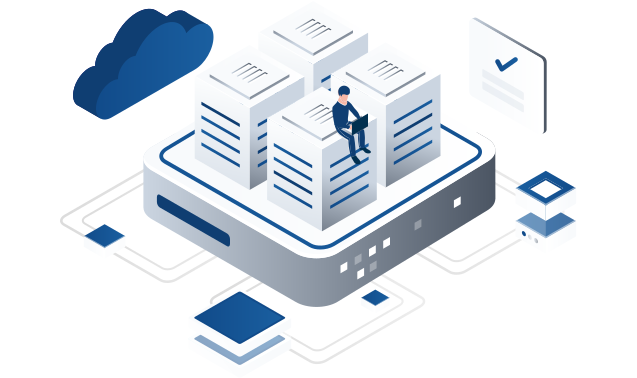
Coordinate high-risk identity operations across heterogeneous IAM systems with a single operational view, explicit ownership, and accountable execution.

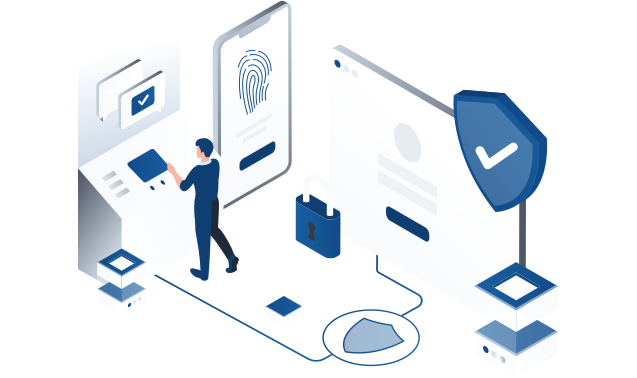
Define permission scopes around specific identity sets through role-based policy so operators can perform approved operations only for the identities assigned to their scope, with time-limited access and clearly bounded authority.
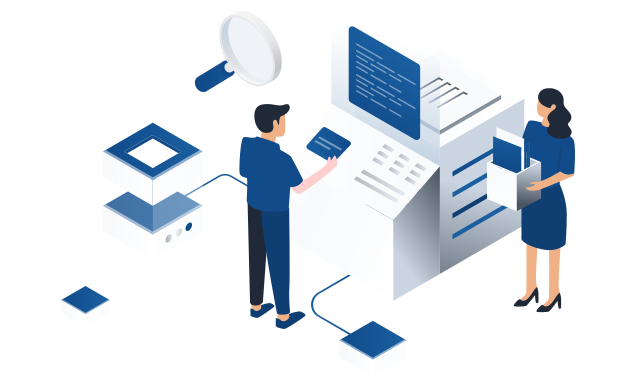
Produce policy-aligned evidence with signed audit records, tenant context, and intervention traceability for internal and external review.
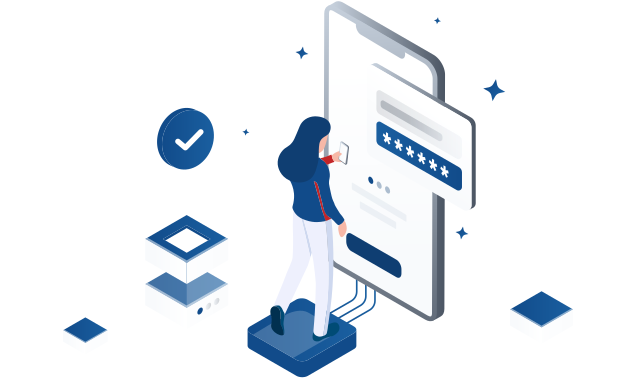
Guide users from registration to secure login with configurable workflows, flexible authenticator enrollment, and consistent corporate branding.
Deployment Options
Isolate tenants with dedicated governance boundaries, operational ownership, and evidence retention policies.
Connect cloud and on-premise IAM domains while preserving policy consistency and intervention control.
Run the platform within your operating model with standards-based integration, explicit responsibilities, and security baselines.